AI search is fundamentally reshaping how users discover brands. Traditional SEO metrics (rankings, CTR, impressions) are no longer enough—you now need to track how often your brand appears inside AI-generated answers across platforms like ChatGPT, Perplexity, Gemini, and Google AI Overviews.
This is where AI visibility monitoring tools come in. They measure your presence, citations, and share-of-voice inside LLM responses—forming the foundation of AI SEO / GEO (Generative Engine Optimization).
Below is a comprehensive, SEO-focused comparison of the best AI visibility tools in 2026.
What to Look for in AI Visibility Tools (SEO Perspective)
- Prompt-based tracking
- LLM coverage (ChatGPT, Gemini, Perplexity, etc.)
- Citation vs mention tracking
- Share of Voice (SoV)
- Historical visibility trends
- SEO data integration
OtterlyAI
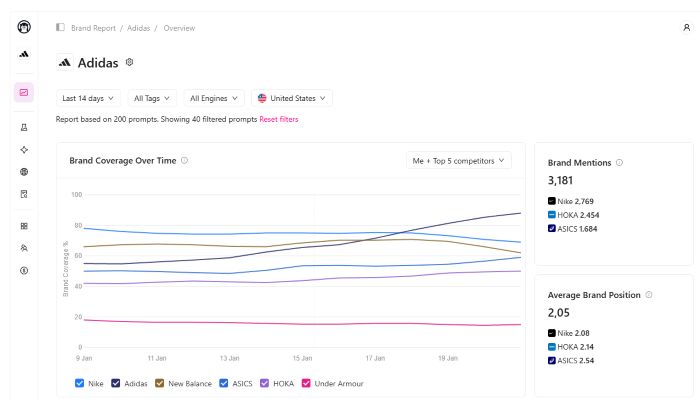
- Tracks brand mentions across ChatGPT, Perplexity, Gemini, AI Overviews
- Prompt library (real user queries simulation)
- Competitor visibility benchmarking
- Sentiment & context analysis
- Historical tracking of AI responses
OtterlyAI stands out as one of the most AI-native visibility tools, built entirely around how LLMs work rather than traditional search engines. What makes it particularly valuable from an SEO perspective is its prompt-first approach. Instead of tracking keywords, you define real-world queries like “best running shoes for flat feet” or “top skincare brands for sensitive skin,” and the tool evaluates how your brand appears in those responses.
This allows SEO teams to shift from keyword targeting to intent and query clustering, which is exactly how AI engines process information. Additionally, OtterlyAI provides insights into how your brand is mentioned—whether it’s recommended, compared, or simply listed—which helps refine both content positioning and messaging. Over time, the historical tracking feature enables teams to measure the impact of content updates or authority-building efforts on AI visibility.
GeoGenie
- GEO-focused visibility tracking (Generative Engine Optimization)
- Prompt clustering and intent grouping
- AI citation tracking (which URLs are referenced)
- Competitor comparison at prompt level
- Content optimization insights
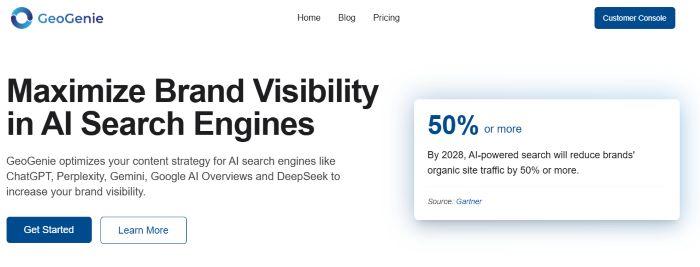
GeoGenie is one of the newer players in the space but is gaining attention for its strong focus on GEO workflows and content optimization. Unlike some tools that primarily focus on tracking, GeoGenie leans more into actionable insights tied to content performance.
From an SEO perspective, one of its most valuable features is prompt clustering. Instead of analyzing queries individually, it groups similar prompts together, allowing teams to understand visibility at a topic or intent level. This is crucial for scaling AI SEO, as optimizing one piece of content can impact multiple related prompts.
Another key strength is its citation tracking, which shows exactly which pages AI engines reference. This helps answer one of the most important questions in AI SEO:
👉 Which of my pages are actually being used as sources?
By combining prompt clustering, citation tracking, and competitor insights, GeoGenie enables teams to move beyond monitoring and into systematic optimization of AI visibility.
SE Ranking AI Visibility Toolkit
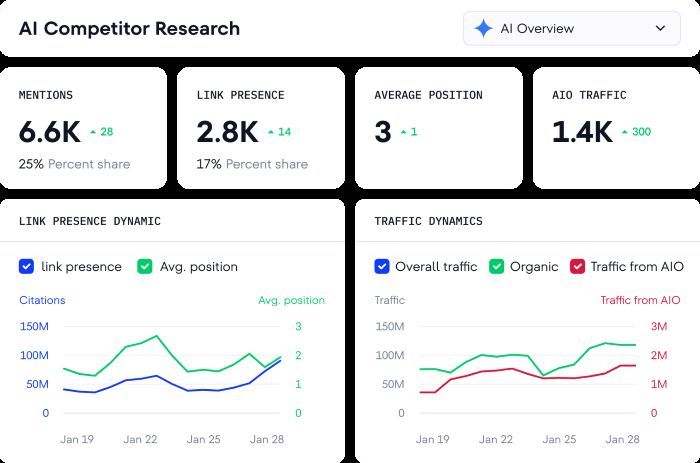
- Tracks mentions inside AI answers
- Shows position within AI-generated responses
- Prompt analysis
- Competitor benchmarking
- Historical tracking
SE Ranking bridges the gap between traditional SEO and AI visibility by integrating both into a single ecosystem. This is particularly useful for teams that don’t want to manage multiple tools. You can track your keyword rankings and, at the same time, understand whether those rankings actually translate into AI presence.
From an SEO standpoint, one of the biggest insights this tool provides is identifying disconnects between rankings and AI visibility. For example, a page ranking in the top 3 may still not be cited in AI answers. This indicates missing elements such as structured data, authority signals, or content depth.
The platform also enables competitor benchmarking within AI results, helping you understand which competitors dominate AI answers and why. This makes it easier to reverse-engineer content strategies and identify high-impact optimization opportunities.
Semrush AI Visibility Toolkit
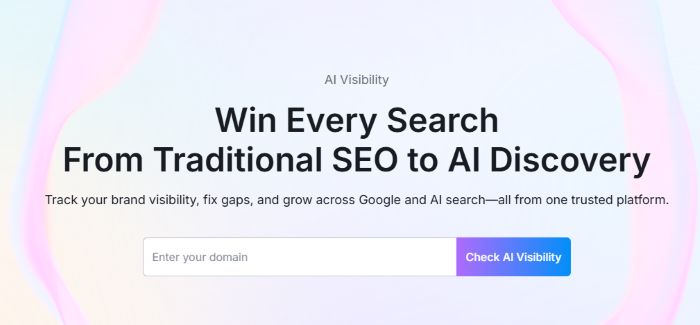
- AI visibility scoring across LLMs
- Prompt monitoring
- Content optimization recommendations
- Integration with keyword, backlink, and traffic data
- Unified dashboards
Semrush is evolving into a full-stack AI + SEO platform, and its AI visibility toolkit reflects that shift. What makes Semrush particularly powerful is not just tracking visibility, but connecting it to actionable SEO workflows.
For example, if your brand is missing from AI answers for a specific query, Semrush can help you:
- Identify relevant keywords
- Analyze competing content
- Improve topical authority
- Strengthen backlink profiles
This creates a closed-loop system where insights directly feed into execution. From a strategic perspective, this is critical because AI visibility is influenced by multiple factors—content quality, authority, and technical SEO.
Another advantage is scalability. For enterprise teams managing multiple markets, Semrush allows centralized monitoring of both traditional and AI performance, making it easier to align SEO strategies across regions.
Ahrefs (Brand Radar AI)
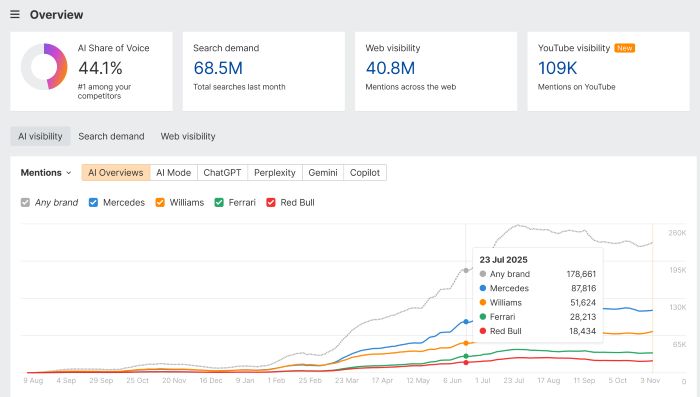
- AI brand mention tracking
- Competitive visibility insights
- Strong backlink and authority analysis
- Content gap identification
Ahrefs approaches AI visibility from an authority-first perspective, which aligns closely with how LLMs determine which sources to trust. Instead of focusing only on prompts, Ahrefs emphasizes the underlying signals that drive AI citations, particularly backlinks and content authority.
This is extremely valuable for SEO teams because AI engines often rely on trusted domains and well-linked content when generating responses. Ahrefs helps you identify:
- Which pages are most likely to be cited
- Which competitors are gaining authority
- Where you have backlink gaps
Additionally, the content gap analysis feature allows you to uncover missing topics that competitors cover—and that AI engines are already referencing. This makes Ahrefs a strong tool for long-term AI visibility growth, even if its prompt tracking capabilities are less advanced than some specialized tools.
Mangools AI Search Grader / Watcher
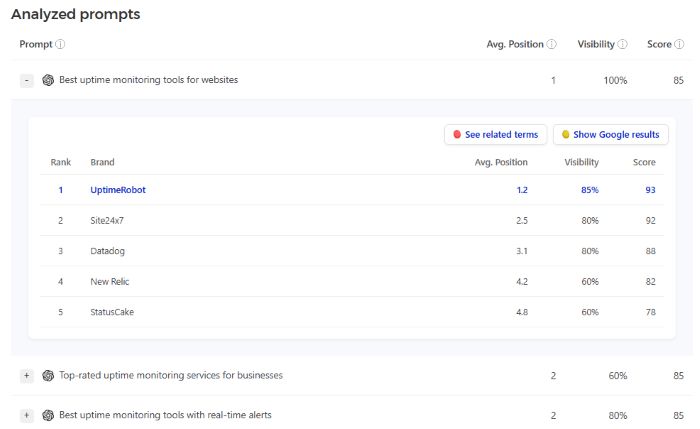
- AI visibility scoring
- Prompt-based tracking
- Competitor comparison
- Keyword + AI integration
- Easy-to-use interface
Mangools provides a simplified entry point into AI visibility tracking, making it ideal for smaller teams or freelancers. While it doesn’t offer the depth of enterprise tools, it excels in usability and quick insights.
From an SEO perspective, Mangools is particularly useful for identifying:
- Which queries trigger AI visibility
- Where your brand stands compared to competitors
- Quick wins for optimization
It can act as a diagnostic tool to validate whether your content is being picked up by AI engines at all. For teams just starting with AI SEO, this is often the first step before investing in more advanced platforms.
Rankability (GEO Tracker)
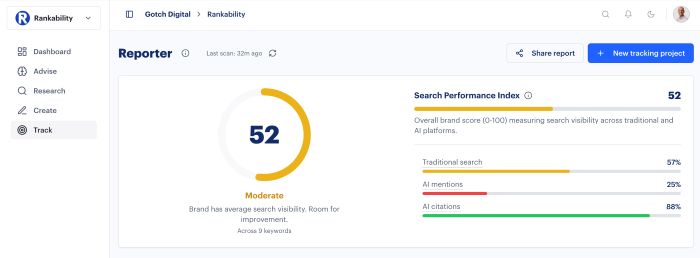
- Multi-engine AI tracking
- Prompt-based rank tracking
- Agency workflows
- Scalable reporting
Rankability is built specifically for Generative Engine Optimization (GEO) and is one of the most agency-friendly tools in this space. Its structure is designed around managing multiple clients, making it easy to scale AI visibility tracking across different industries and markets.
The tool focuses heavily on prompt-level performance, allowing you to track how visibility changes across different AI engines. This is particularly important because results can vary significantly between ChatGPT, Gemini, and Perplexity.
From an SEO perspective, Rankability enables agencies to:
- Standardize AI tracking processes
- Report visibility improvements to clients
- Identify optimization opportunities across accounts
This makes it not just a tracking tool, but a client-facing reporting solution for AI SEO services.
Profound (Enterprise AI Visibility Platform)
- Multi-engine coverage (10+ platforms)
- Large-scale prompt tracking
- Advanced analytics
- Enterprise-grade dashboards
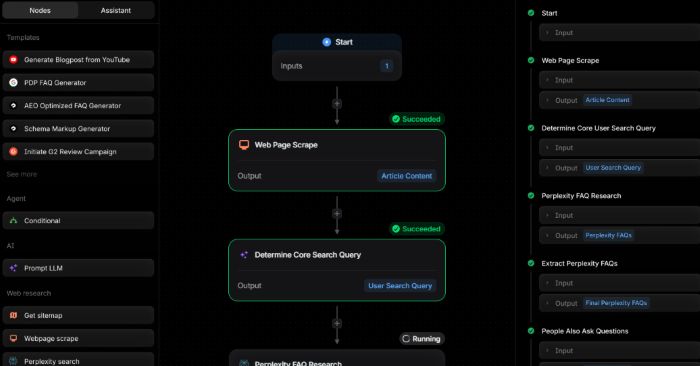
Profound is designed for organizations that need large-scale AI visibility tracking across multiple markets and product lines. Its biggest strength is the ability to process thousands of prompts simultaneously, making it ideal for global brands.
From an SEO perspective, this enables:
- Cross-market visibility analysis
- Localization insights
- Enterprise-level reporting
It also provides deeper analytics compared to lighter tools, helping teams understand patterns in AI responses and how visibility evolves over time.
For companies investing heavily in AI SEO, Profound offers the infrastructure needed to move from experimentation to fully operational AI visibility strategies.
AIclicks
- Real AI prompt discovery
- Automated data collection
- AI visibility insights
- Simple setup
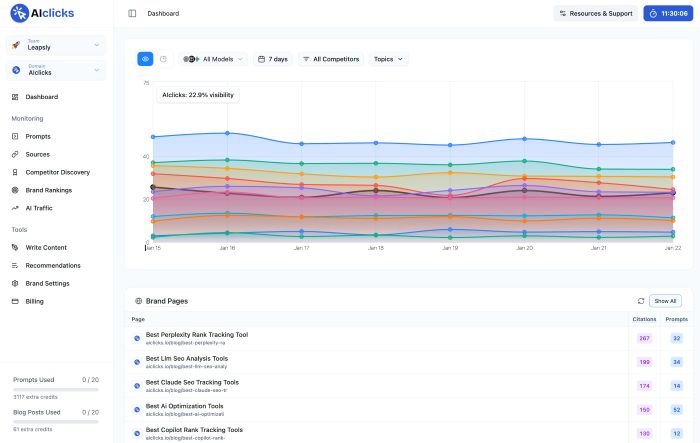
AIclicks focuses on one of the most overlooked aspects of AI SEO: understanding what users actually ask AI systems. Instead of starting with keywords, it surfaces real prompts being used across platforms.
This is extremely valuable for SEO because it allows teams to:
- Build content around real user intent
- Identify emerging trends early
- Optimize for conversational queries
In many cases, traditional keyword tools miss these queries entirely. AIclicks fills that gap by providing prompt-level demand insights, which can then be used to create highly targeted content.
HubSpot AEO Grader
- AI visibility scoring
- Share-of-voice analysis
- Sentiment tracking
- Source authority insights
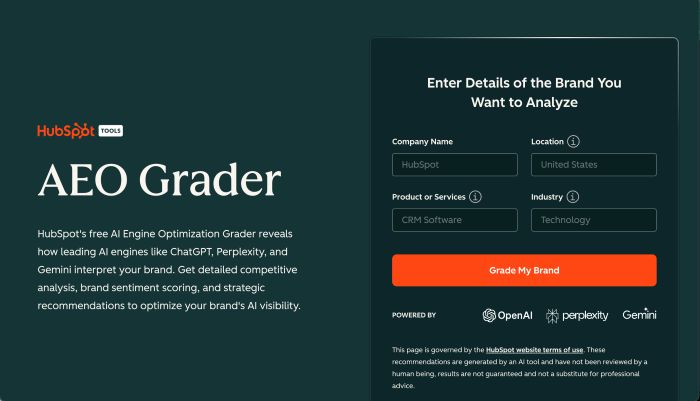
HubSpot’s AEO (Answer Engine Optimization) tool focuses on the quality and perception of brand mentions, not just their frequency. This is an important distinction because being mentioned in AI responses is not enough—you need to be positioned as a trusted and authoritative source.
The tool evaluates:
- How often your brand appears
- Whether it’s recommended or neutral
- Which sources AI relies on
From an SEO standpoint, this aligns closely with entity-based optimization. It helps you understand how your brand is perceived within the broader information ecosystem and what needs to be improved to increase credibility.
This makes HubSpot particularly useful for brands combining SEO with PR and content marketing efforts.

